

How it works
Cernel sits between your product data source (like Shopify) and the enriched content your customers see. You import your product catalog and Cernel automatically classifies every product into its Cernel Taxonomy, so your catalog is organized without any manual setup. From there, you use AI agents to generate content for each product: descriptions, materials, colors, sizing, meta titles, and more. Instead of writing each product description by hand, you set up agents once with your brand voice, product guidelines, and the specific content rules for each category. Then Cernel generates content across your entire catalog in minutes. You review, approve, and push the results back to your store.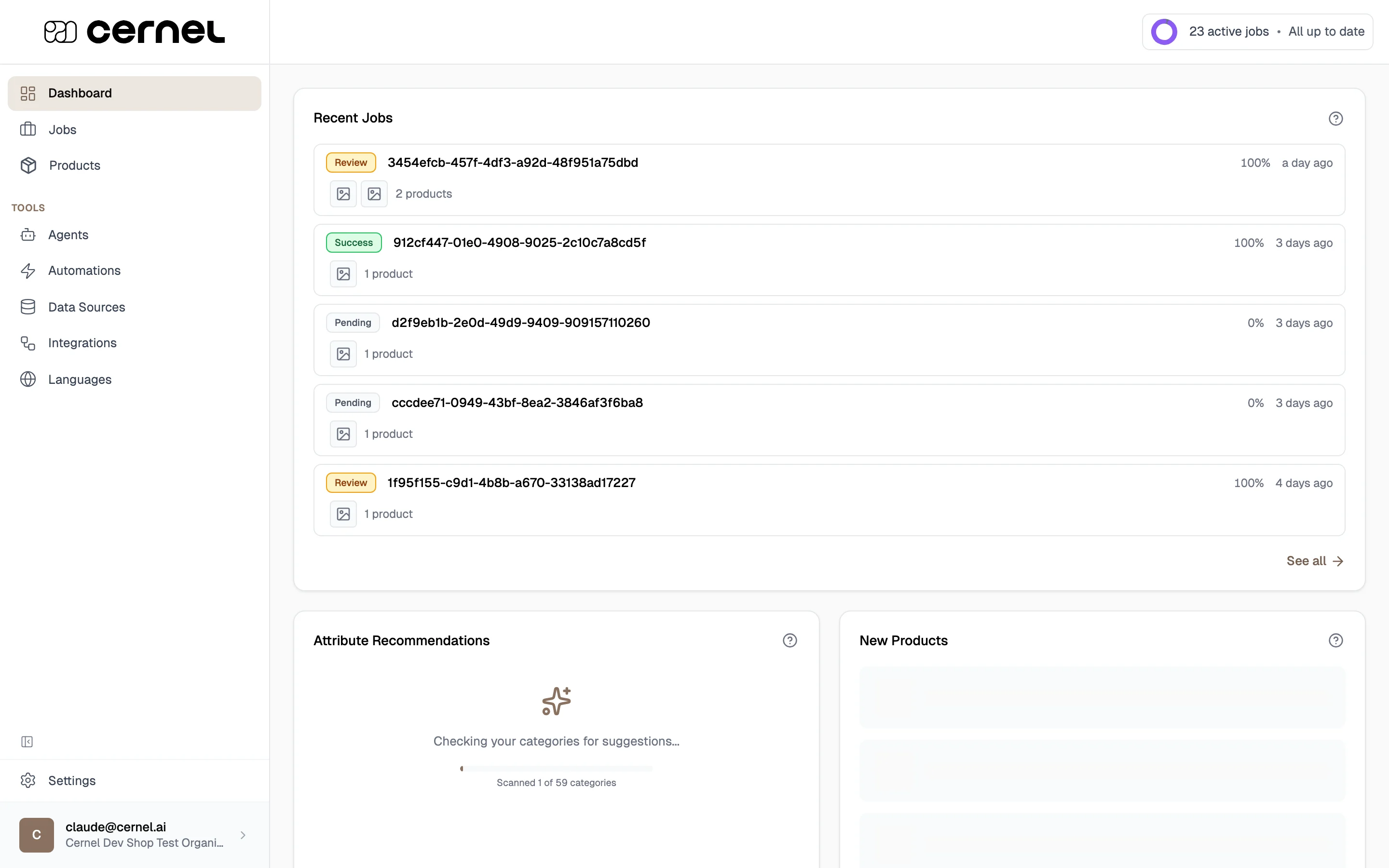
The Cernel dashboard: stats, AI recommendations, and job activity at a glance
Why teams use Cernel
Scale product content without scaling your team
Hundreds or thousands of products need descriptions, meta data, and structured attributes. Cernel generates all of it from your existing product data and the context you provide, with no copywriting team required.
Keep content consistent across your catalog
AI agents follow the same rules for every product. Your brand voice, terminology, and formatting stay consistent whether you have 50 products or 50,000.
Get new products to market faster
Set up automations to enrich new products the moment they arrive. No bottleneck waiting for someone to write descriptions before a product goes live.
Control the output before it goes live
Every piece of generated content goes through a review and approval step. You stay in control of what gets published to your store.
Core concepts
Understanding a few key ideas will help you get the most from Cernel.Cernel Taxonomy
Cernel Taxonomy
The Cernel Taxonomy is a hierarchical category structure maintained by Cernel, for example, Apparel & Accessories > Shoes > Running Shoes. When you import products, Cernel automatically classifies each one into the right category, so you don’t set up or maintain the taxonomy yourself. Each product’s category determines which attributes and agents apply to it, making the taxonomy the backbone that drives every enrichment.
Attributes
Attributes
Attributes are the data fields that AI fills in for your products, like descriptions, meta titles, materials, and colors. Cernel supports seven attribute types: Text, HTML, Single Select, Multi Select, External Data, Media, and Picker (Preview). You configure attributes at the category level, and they automatically apply to all subcategories beneath it.
Agents
Agents
An AI agent is a configured AI that generates a specific piece of content for your products. You set up its prompt, tone, and references to your brand context once, test it live in a sandbox on real products, and link it to attributes across your taxonomy. Agents can also depend on each other, so one agent’s output can feed into another, letting you chain work like “use the product description to write a meta description, then pick the best product image.” Cernel runs every agent in the right order when you enrich.
Data Sources
Data Sources
Data Sources are your organization’s context library: brand guidelines, product specifications, target audience descriptions, and other reference material. You create entries in Tools > Data Sources and reference them in agent prompts so the AI produces content that matches your specific needs.
Enrichment
Enrichment
Enrichment is the process of AI agents generating attribute values for your products. You select products, choose which attributes to generate, and start a job. Cernel tracks the progress and lets you review the results before publishing.
What you can connect
Cernel works with your existing product data through four integration channels:Shopify
Two-way sync: pull your catalog in and push enriched content back to Shopify, including metafields.
CSV Import & Export
Upload product data via spreadsheet and export enriched results for use anywhere.
Product Feed
Connect to product feeds for automated data ingestion from external sources.
Public API
Programmatic access for custom integrations and automated workflows.